


Correct sample handling
What matters is not only the test itself, but how samples are taken and prepared so that the result reflects the real quality of the batch.
Independent concrete testing is not a box-ticking exercise. It shows how Bereke Group confirms mix strength, compares fact against project requirements, and removes blind spots where a material error would be too costly.
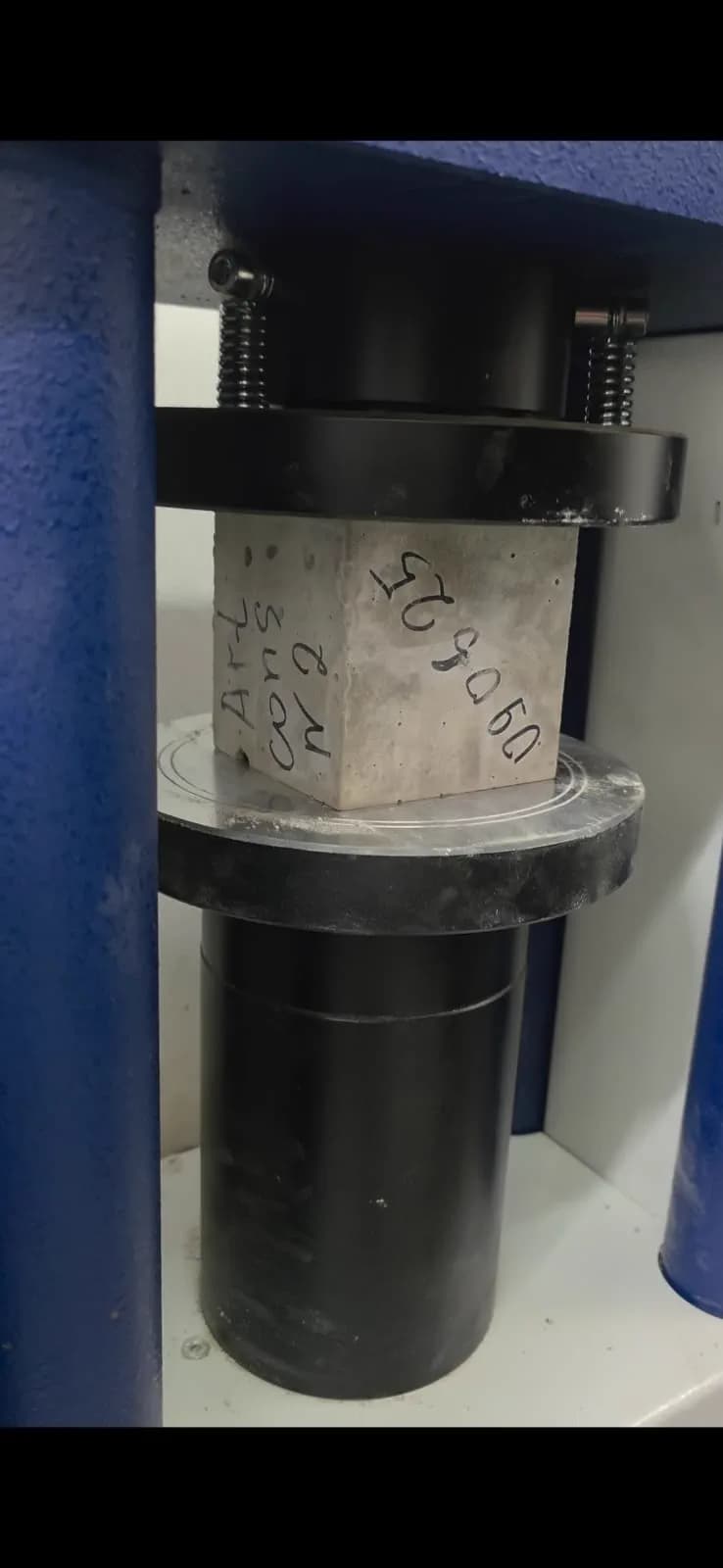
On site, concrete can be accepted by paperwork and appearance, but that is not enough when the material is part of the load-bearing structure. Real confidence appears when the mix passes an independent check and its properties are confirmed by testing rather than supplier language.
That is why Bereke Group treats the laboratory stage as part of its engineering logic. We care not only about the existence of a protocol, but also about how samples are taken, how the test is run, and how the result relates to the project requirements.
A laboratory turns quality from abstraction into measurable reality. Marketing wording becomes secondary because what matters here is strength, grade compliance, batch consistency, and the correct interpretation of the findings.
For the client, that means more grounded trust. The house does not rely on a promise that the concrete is good; it relies on a verification discipline in which a critical material passes through an independent control point.
Laboratory testing matters because it proves that material quality is confirmed by measurement rather than assumption.
The practical signals that show whether the material is genuinely verified rather than simply accompanied by formal paperwork.
What matters is not only the test itself, but how samples are taken and prepared so that the result reflects the real quality of the batch.
The laboratory shows whether the concrete reaches the declared parameters and whether the actual characteristics align with the project's expectations.
A strong review ends not with a number for its own sake, but with a clear conclusion about whether the material can be trusted in the intended structure.
An external laboratory reduces the risk of supplier self-assessment and makes the quality conversation more objective.
A testing protocol is valuable only when it is part of the project's engineering logic: confirming the material, reducing error risk, and informing real decisions about quality.
When the discussion is about foundations, slabs, and other critical structural stages, a contractor cannot afford to rely on assumptions. That is why laboratory verification matters as a distinct control layer between delivery and confidence in the result.
Concrete may arrive with a passport, a certificate, and a confident supplier explanation, but that is not enough for responsible construction. A material that shapes the load-bearing capacity of a house needs to be confirmed by measurable evidence.
An independent laboratory does exactly that. It translates the quality discussion into facts and shows whether the mix reaches the required strength and matches the assumptions behind the design decision.
A strong quality process is built not only on internal promises, but also on external verification. When concrete passes through an independent laboratory, that adds an objective checkpoint and lowers the risk of accepting a critical material too formally.
For Bereke Group, this is not a separate marketing gesture. It is part of project discipline. If the material is confirmed by an independent test, the team can move forward with more engineering confidence, and the client receives a real trust proof rather than a generic statement about quality.

When a company shows laboratory checks for critical materials, it communicates something important: responsibility does not stop at supplier selection or on-site delivery acceptance. It continues where quality needs to be externally confirmed.
That is a strong signal of engineering culture. The team is not merely claiming reliability; it is building a chain in which material choice, supervision, documentation, and responsibility are linked together. For the client, that means fewer blind spots and a more predictable route to the result.
A concrete laboratory review matters because it makes quality measurable. It shows that Bereke Group confirms critical materials not only through words and documents, but through independent testing inside a broader project-control system.
Independent laboratory verification reduces uncertainty in one of the most sensitive parts of construction: the quality of concrete that the structure depends on.
You rely not only on supplier language, but on testing that shows the real characteristics of the mix.
The team can explain what is being checked and why the laboratory result matters for a specific project stage.
When a critical material goes through independent verification, the chance of accepting a problem on trust becomes lower.
The laboratory shows that Bereke Group builds quality through procedure rather than post-fact promises.
For Bereke Group, the laboratory is not separate from construction. It works as one layer in a system where material quality, supervision, documentation, and engineering decisions reinforce each other.
That is why a laboratory review is useful to the client: it shows how the company reduces risk before an error has the chance to become part of the structure itself.
If you want to understand how Bereke Group connects laboratory checks to overall project quality, start with these routes.
See how verifiable control, acts, laboratory checks, and responsibility are structured inside Bereke Group.
See how the quality system works inside a real build, from preparation through structural stages and delivery.
Other expert-video materials, behind-the-scenes reviews, and editorial articles about company processes.
Evergreen materials for people who want deeper support around quality, risk, and construction decisions.
If you want to see how checks like this are built into your future project, move to consultation or open the core house-construction page.